
Compound · Copper complex with a tripeptide
GHK-Cu
Copper tripeptide-1 · Glicil-histidil-lisina cobre
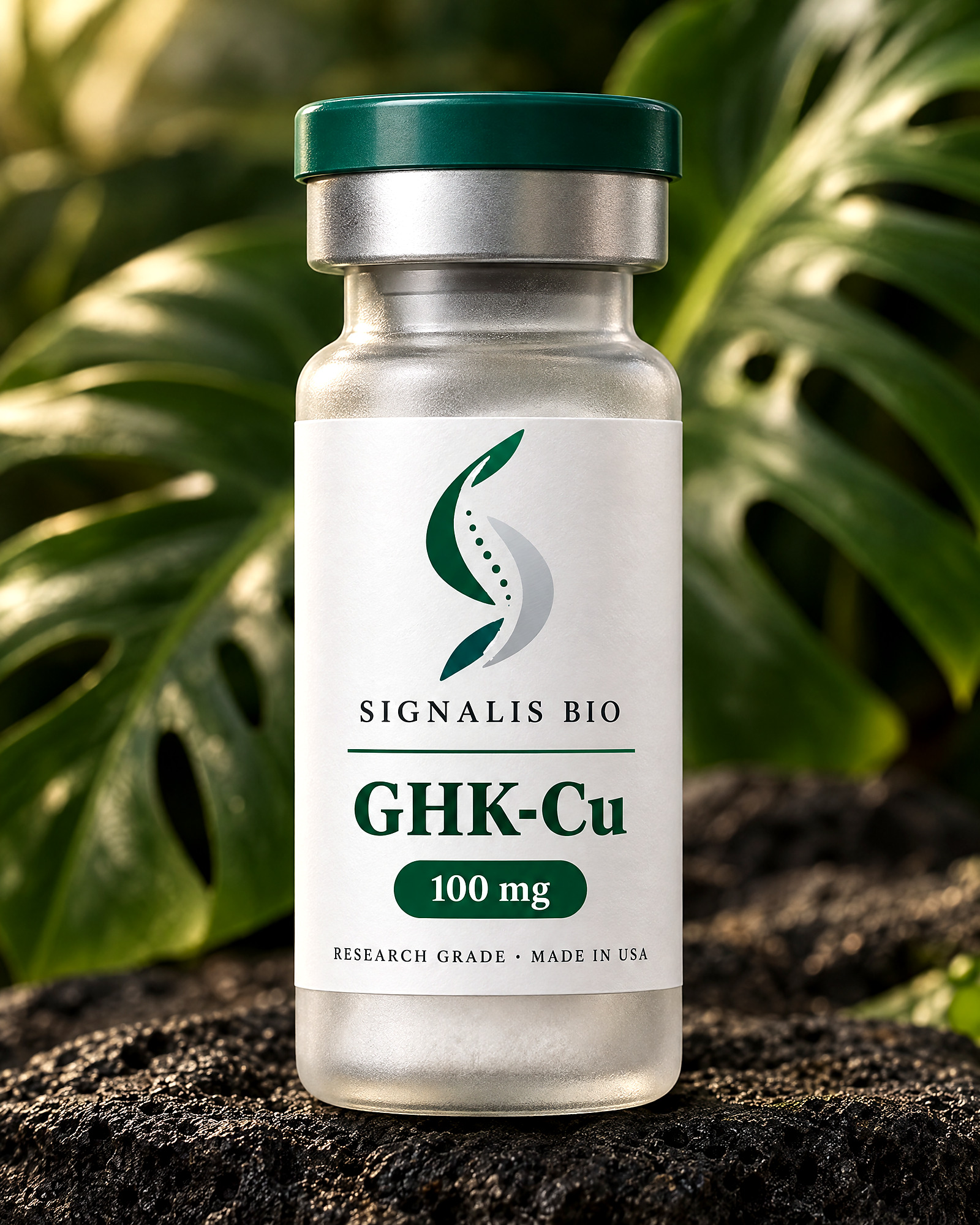
FormatLyophilized vial containing 100 mg, Signalis Bio, research grade, made in the USA.
What science explores · not a promise
- Skin and collagen
- Extracellular matrix
- Gene expression
What it is
GHK-Cu is the complex formed by glycine, histidine, and lysine with a copper ion. The GHK tripeptide occurs in human fluids and raises questions about metal coordination and cellular communication. Researchers examine its relationship with fibroblasts, extracellular matrix proteins, and gene expression. Its presence in cosmetic science does not make every material with this name clinically validated or make its different formulations equivalent to one another.
Research distinguishes the chemical identity of the material, proposed mechanisms, and observations obtained in each experimental model. A signal measured in cells is not equivalent to an effect demonstrated in people. The catalog presentation is research grade material, not an approved medicine. This description organizes scientific questions and the limits of the evidence; it is not a promise of health changes or a personal recommendation.
Origin
GHK was identified in human plasma in 1973 through academic research in the United States. Its ability to form a copper complex led to later studies of signaling and extracellular matrix biology. Catalog material is produced for research and is not necessarily obtained by extraction from human fluids.
How it is studied
Research uses fibroblast cultures, tissue models, and human dermatology studies of specific formulations. Measurements include collagen, elastin, gene activity, and skin surface parameters. Copper coordination and sample composition matter when comparing experiments. Findings from cosmetic research do not automatically validate a research vial or establish equivalent evidence across different materials. Human data are limited for this catalog presentation. Researchers distinguish associations, mechanisms, and experimental changes; these are not interchangeable conclusions. The composition and context of each study matter. These measurements make no promises for people and do not establish the commercial product as an approved medicine.
Related lessons



Related readings
Anatomy of a peptide: from amino acids to a signal
Reading · 4 min
Anatomy of a peptide: from amino acids to a signal
A short chain can carry considerable molecular information: its sequence, shape and surroundings explain how researchers investigate a potential cellular signal.
What science explores in four areas, explained without promises
Reading · 4 min
What science explores in four areas, explained without promises
Four areas organize scientific questions about peptides and other molecules, but every study requires attention to its model, measurements, and limits.
Dr. Peptide is a virtual presenter created with artificial intelligence; she is not a healthcare professional. This content is educational and is not medical advice, diagnosis or treatment. Decisions about your health belong with a licensed professional. Research-grade products; sale to adults 18+ only.
Follow us on Instagram · @Signalisbio