
Compound · Dissolvable thin film format
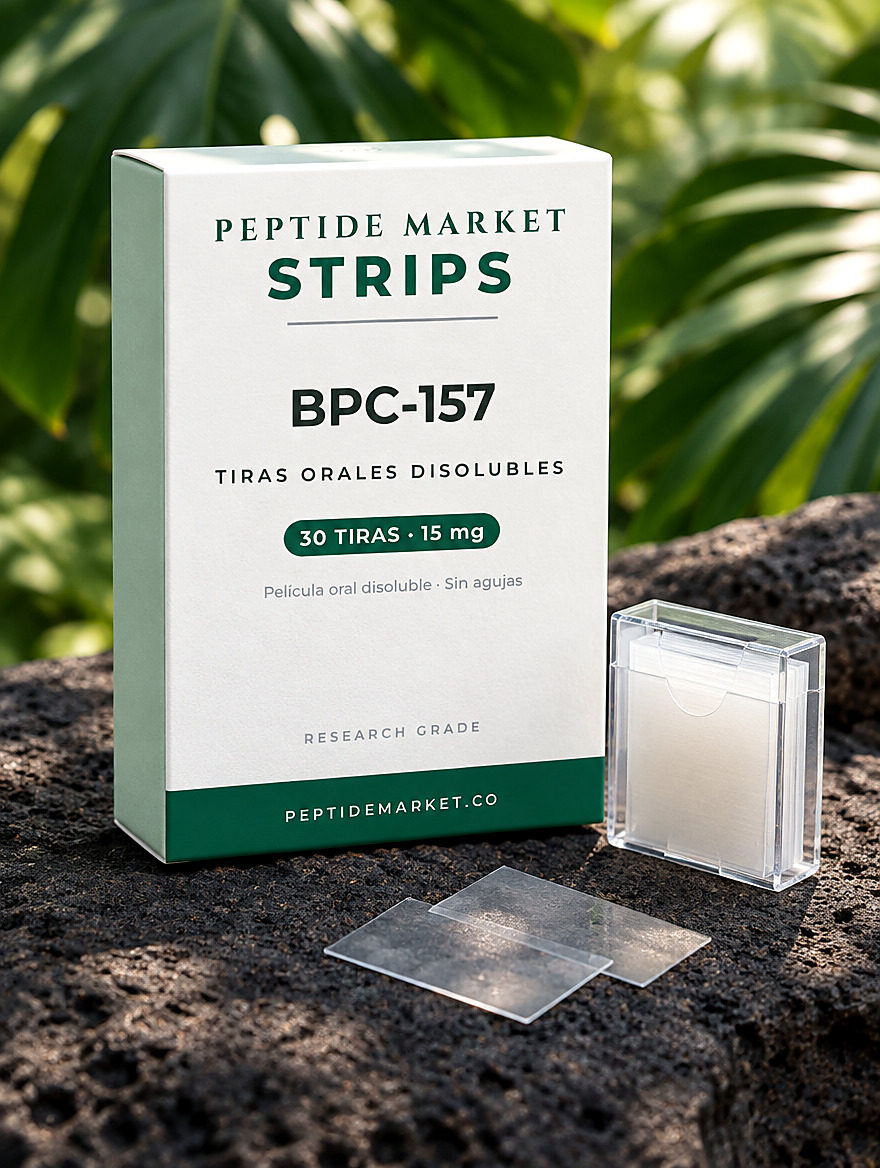
Peptide Market Strips oral strips
Películas orales finas · Oral thin films
FormatPeptide Market Strips: five boxes of 30 strips each, thin films that dissolve in the mouth. Total content per box: BPC-157, 15 mg; NAD+, 3000 mg; Glow (GHK-Cu + BPC-157 + TB-500), 60 mg + 7.5 mg + 7.5 mg; CJC-1295 + Ipamorelin, 7.5 mg + 7.5 mg; glutathione, 3000 mg.
What science explores · not a promise
- Repair and recovery
- Skin and collagen
- Energy metabolism
- Growth hormone axis
- Redox biology
What it is
Oral strips are thin films that dissolve in the mouth, an established format in pharmaceutical technology. This page groups five Peptide Market Strips boxes as physical presentations rather than as a single molecule. Their ingredients include peptides, blends, and a coenzyme. Scientific questions concern those compounds; sharing a format does not establish equivalence between them or justify transferring conclusions from a vial or a different formulation to these films.
Research distinguishes the chemical identity of the material, proposed mechanisms, and observations obtained in each experimental model. A signal measured in cells is not equivalent to an effect demonstrated in people. The catalog presentation is research grade material, not an approved medicine. This description organizes scientific questions and the limits of the evidence; it is not a promise of health changes or a personal recommendation.
Origin
Thin films are manufactured materials, not isolated natural structures. They developed in pharmaceutical technology laboratories during the twentieth century and became more commercially prominent toward its end and the beginning of the next. That history of the format is separate from evidence concerning each particular ingredient.
How it is studied
Ingredient research includes cell cultures, animal models, and human studies of specific formulations. Measurements concern vascular signals, matrix proteins, redox variables, energy metabolism, or growth axis signals, depending on the compound. Physical film evaluations examine uniformity and stability; these tests do not replace evidence about the ingredient or exact formulation. Human data are limited for this catalog presentation. Researchers distinguish associations, mechanisms, and experimental changes; these are not interchangeable conclusions. The composition and context of each study matter. These measurements make no promises for people and do not establish the commercial product as an approved medicine.
Related lessons



Related readings
Lyophilized vial or oral strip: what changes and what does not
Reading · 4 min
Lyophilized vial or oral strip: what changes and what does not
Packaging and storage distinguish two formats, but purity, identity, and batch documentation remain essential questions when reading a research material listing.
Community questions · Episode 1
Reading · 4 min
Community questions · Episode 1
Ten common questions clarify basic concepts, document reading, and the boundaries of educational content, with brief answers separating information from personal recommendations.
Dr. Peptide is a virtual presenter created with artificial intelligence; she is not a healthcare professional. This content is educational and is not medical advice, diagnosis or treatment. Decisions about your health belong with a licensed professional. Research-grade products; sale to adults 18+ only.
Follow us on Instagram · @Signalisbio